

Hazvinei Mwanaka
BIKITA- Where there is despair, she restores hope. And those we stigmatize are her best friends.
Such is the case of Rumbidzai Mbudzi, a 39-year-old specialist gynecologist who has dedicated her life to repair women who have obstetric fistula.
Obsteric fistula is a childbirth injury that occurs among women when complications during labor and delivery lead to a hole forming between the birth canal and the bladder or rectum. The injury results in uncontrollable leakage of urine or feaces.
This condition leaves victims isolating themselves from the rest of the world and suffering in silence, with society shunning them sometimes.
It is such patients that Mbudzi endears herself with, day-in-day-out during her working hours.
One such patient, Elizabeth Dandauta, a lady from Gokwe who suffered obstetric fistula since 2011, says the condition made her ashamed as she was always soiling herself in a short space of time that left her living in her own cocoon.
“When you leave a seat, even in a short space of time, it will be wet, that makes you feel ashamed as people will start looking at you and asking so many questions making you feel ashamed, uncomfortable and this is very painful,” she told HuMFOZ.
And such cases have shocked Mbudzi, an Algerian trained doctor, to the bone.
“When I came here, I was quite shocked, I didn’t know that obstetric fistula was such a huge problem. I knew that it existed but had no idea about the extent and the numbers of people who are affected,” Mbudzi told HuMFOZ on the sidelines of the commemorations of the World Fistula Day.
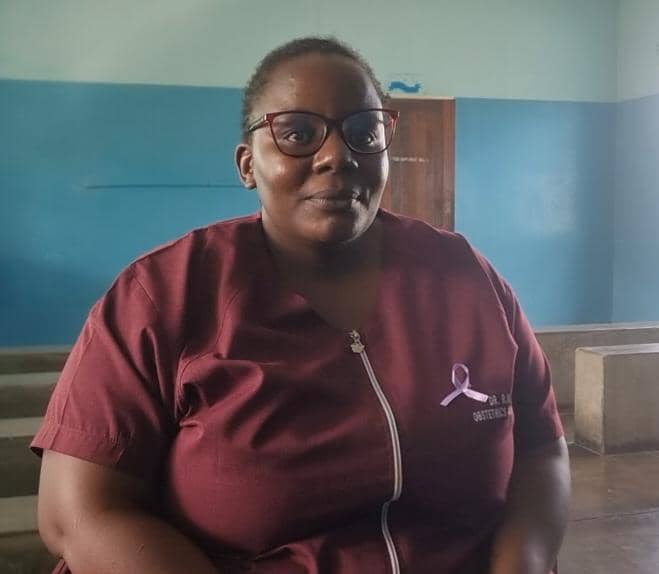
Rumbidzai Mbudzi
Rumbidzai started working for the Ministry of Health and Child Care in 2014 as an intern. In 2017 she moved to Bulawayo at United Bulawayo Hospitals (UBH) in the department of Obstetrics and gynecology as a medical officer.
That is when she decided to take the bold move to specialize in obstetric fistula repairs.
“I then started my training to be a specialist Obstetrician and Gynecologist. During the course of my training programme, that is when I heard about the repair of obstetric fistula patients and I was invited by the ministry to come and train. So I thought to myself let me go and learn since I also want to be a specialist gynecologist,” said Mbudzi.
Now she is a visiting doctor at Mashoko Christian Hospital, one of the six hospitals in the country that has been capacitated by government and development partners to conduct obstetric fistula repairs.
“I think I started in 2023 and we were getting more patients, and when I listened to the stories of the different women who came for surgeries, I was very touched and was so heartbroken. The story that got to me very much was that of a woman who had lived with obstetric fistula for about 42 years.
“She got pregnant in 1980, and had difficulties in delivery and ended up losing her baby and after that she had fistula and her husband left her,” she added.
Rumbidzai said that the woman never remarried or had another child, adding that those are the kind of stories that they hear every day from women with obstetric fistula.
“This touched me and inspired me to take part and be part of this programme. It was just beyond just observing for training purposes, I felt the need to help, assist and give back to community. When you see the impact of the programme were people’s faces change and would now be smiling. They start making plans, can go back to school, church, start a business, that is essentially things that were not possible becoming a reality,” she added.
To her it is an emotional situation that got her very much attached to the programme and now she cannot stop participating.
“So when I qualified as a specialist Gynecologist in 2024, I then decided to further my training specifically on obstetric fistula, get certified and be better equipped. With MOHCC and their partners bringing in fistula surgeons from different parts of the world, I want to be capacitated so that I get certified as a fistula surgeon,” she said.
According to Rumbidzai she usually comes every quarter during camps when obstetric fistula repairs are done and usually it takes two to three weeks and at times can assist around 35 women.
“Some will be leaking urine others feaces,” she says.
She travels by bus from Bulawayo to Mashoko Christian Hospital, a journey she describes as tiresome but not regrettable because of the life-changing surgery work she will be coming to do.
“The journey from Masvingo to Mashoko Christian Hospital is around 150km but I depart around 12pm and arrive around 6pm. The road is so bad, and every time I come to Mashoko my luggage will be in the boot of the bus, they will be very dirty, and as soon as you arrive, you have to start cleaning the luggage.
“So I think if the community could get help in fixing the roads it will not just help us but patients coming in, remember these are people who are leaking urine or feaces and they have to use that road so you can imagine the discomfort they endure along the way,” she added.
She thanked other development partners like Artemedis, the Fistula Foundation and the United Nations Population Fund (UNFPA) are working with government to provide surgical intervention.
However, she says more awareness and advocacy work needs to be done to educate society on the condition and help those secretly living with the condition to come out of their shells and seek help.