

By Tatenda Chitagu in Dakar, Senegal
The United Nations (UN) has urged African leaders to increase funding in their agriculture sectors and go beyond mere rhetoric in their promise to deliver indeginous food systems.
Mr Claver Gatete, UN under-secretary-general and executive secretary of Economic Commission for Africa (ECA), made the call at the 19th Africa Food Systems Forum (AFSF) that opened here at the Abdou Diouf International Conference Center yesterday
His remarks come in the wake of cuts in United States aid funding, which was a major lifeblood for most of the continent’s sectors, agriculture included.
“Implementation, not intention, will feed our people,” Gatete said, adding; “Food systems transformation is more than feeding people. Financing is therefore crucial as the era of abundant aid is over. In a post-Official Development Assistance (ODA) world, domestic resources and private capital must lead the way,” he said.

Mr Claver Gatete, UN under-secretary-general and executive secretary of Economic Commission for Africa (ECA) speaking at the 19th Africa Food Systems Forum (AFSF) that opened here at the Abdou Diouf International Conference Center yesterday (Pic courtesy of UN)
Among the dignitaries in attendance at the forum are host president, Bassirou Diomaye Diakhar Faye; Rwandese president Paul Kagame; Hailemariam Dessalegn, former Prime Minister of Ethiopia and chair of AGRA, Zimbabwean permanent secretary in the Ministry of Lands, Agriculture, Fisheries, Water and Rural Development, Obert Jiri, as well as government ministers and several leaders of International Non-Governmental Organizations (INGOs).
Gatete assured African leaders of the UN’s ‘full support for Africa’s agricultural transformation agenda.’
He said Africa is home to the youngest population in the world, with energy and ideas to drive transformation, yet too many of the youths remain unemployed.
“This is the paradox of Africa: a continent with extraordinary potential but still marked by persistent hunger and heavy dependence on external markets. How can it be that a continent that should be the breadbasket of the world remains unable to feed its own people?”
Andrew Adem, Food Systems Coordinator at the Alliance for Food Sovereignty in Africa (AFSA), a continental coalition promoting food sovereignty and sustainable agriculture, said African governments have been failing in their own commitments.
“There is a lot of commitment with little action at national level. Apparently, it has been three consecutive declarations by African governments committing to allocate ten percent of their national budgets to agriculture. The first declaration was in Maputo, then came the Malabo and recently the Kampala declaration. In all the three declarations, African governments have been failing to fulfil their commitments,” Adem said.
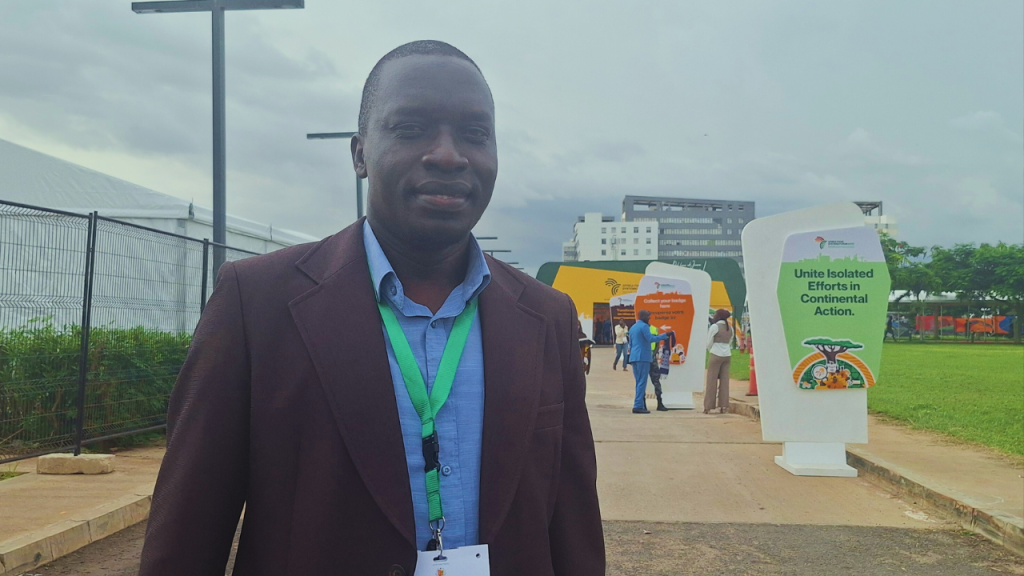
Andrew Adem, Food Systems Coordinator at the Alliance for Food Sovereignty in Africa (AFSA), calls for increased funding of agriculture sectors by African governments with a deliberate target on smallholder farmers. (Photo/Kass Media)
Of the little funding allocated by national governments, Adem added, the money is not cascading down to smallholder farmers, who are the backbone of Africa’s food systems.
“The other problem is that the funding is not going to smallholder farmers. As AFSA, the biggest movement on the continent, we expect more funding going to smallholder farmers, more funding into access to their training, access to agro ecological inputs and building territorial markets. We also want the funding to be increased. That is why there is low production and productivity, as well as the huge food import bill. The core issue of funding needs to be addressed,” he said.
Gatete stressed that African leaders should go beyond policies and move to implementation and delivery; aligning budgets with commitments, strengthening accountability and measuring progress transparently.
He urged Africa to mobilize domestic resources and private investment to cut its huge food import bill, which spiralled to US$115 in 2024; expand tax base; digitize economies to reduce illicit financial flows; reform expenditure and leverage assets like pension funds and remittances so as to finance transformation from within.
The UN under-secretary-general and executive secretary of ECA also called for the empowerment of small-scale agri-preneurs, women and youth, as well as investment in infrastructure-from energy, roads, logistics, irrigation, to digital systems.
Under the Kampala declaration in January this year, Africa adopted the Comprehensive Africa Agriculture Development Programme (CAADP) Strategy and Action Plan (2026–2035) that seeks to increase agrifood output by 45% and to reduce post-harvest losses by 50% by the end of 2035. CAADP also seeks to increase the share of locally processed food to 35% of agrifood GDP within the same period.
Experts however warn that without political will and meaningful funding, the ambitious blueprint will remain a paper tiger.